Six pairs of makers have brought the techniques of Japan's Tokai region to a gallery at the V&A in London. Each collaboration asks which qualities survive when a technique leaves the object it was developed to make.
The project joins workshops in Gifu, Aichi and Mie with six international designers. Its founder, Hideki Yoshimoto, has assembled a group that reaches beyond a single design capital. Among the participants are Atang Tshikare from South Africa, Australian designer David Caon and the Italian-Singaporean studio Lanzavecchia + Wai. The display remains in Room 64b until 30 September.
Paper becomes a room
The clearest transformation may be Grid Unwoven. Washi maker Takanori Senda and Lanzavecchia + Wai have made a self-standing screen in Mino paper. During production, water and gravity allow the fibres to gather unevenly, leaving a surface denser towards the top and more open below. A programmed light behind the screen makes the paper's thickness legible across time.
Its achievement lies in controlling a large vertical sheet while allowing the fibre to remain visibly irregular. The familiar geometry of a shoji persists, while paper becomes the spatial event.
Shibori carries the light
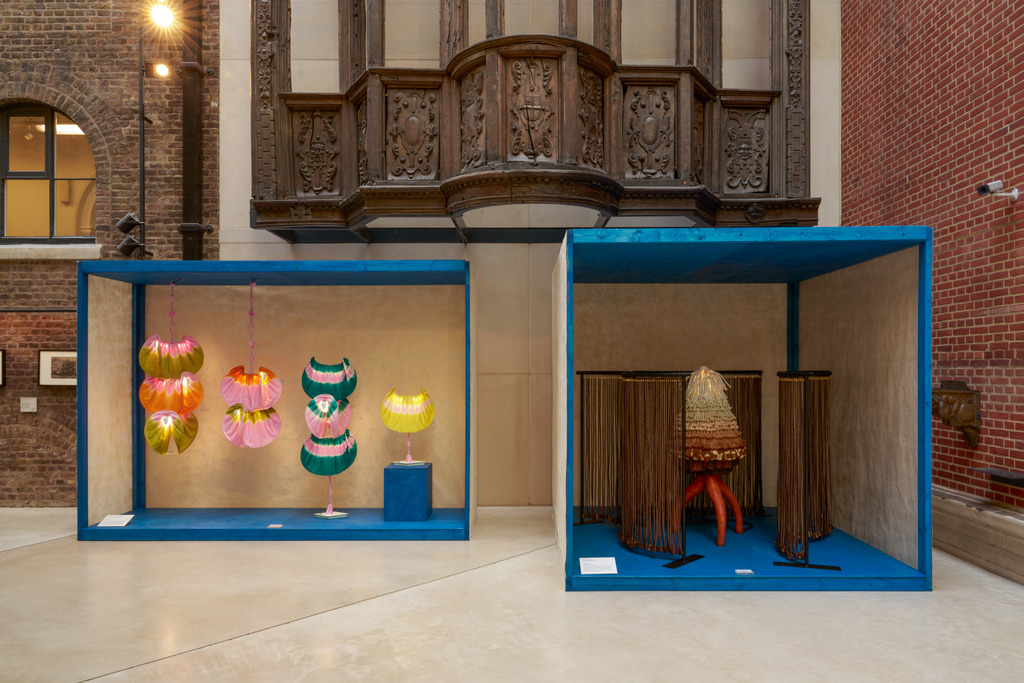
Kataginu, made by Bethan Laura Wood with Hiroyuki Murase of Suzusan, moves Arimatsu-Narumi shibori from clothing into lighting. The work takes its name and shape from a Japanese sleeveless garment with pronounced shoulders. Tying, stitching, folding and dyeing give its fabric depth that changes with the lamp's light. The retained marks of making let the viewer read how the cloth was manipulated.
Murase is the fifth-generation successor to a family involved in this Aichi dyeing tradition. Here, continuity is visible in the precision of the technique; change arrives through scale, colour and the decision to turn the textile into a luminous object.
A braid becomes architecture
Tshikare's Yamollo, made with Iga kumihimo artisan Tomoyuki Matsuda, gives braided cord a sculptural and architectural task. Earth-coloured threads descend around a lit form; a related shield works as a divider. At this scale the gradation of the braid reads from a distance, while exposed threads near the base return attention to the hand.