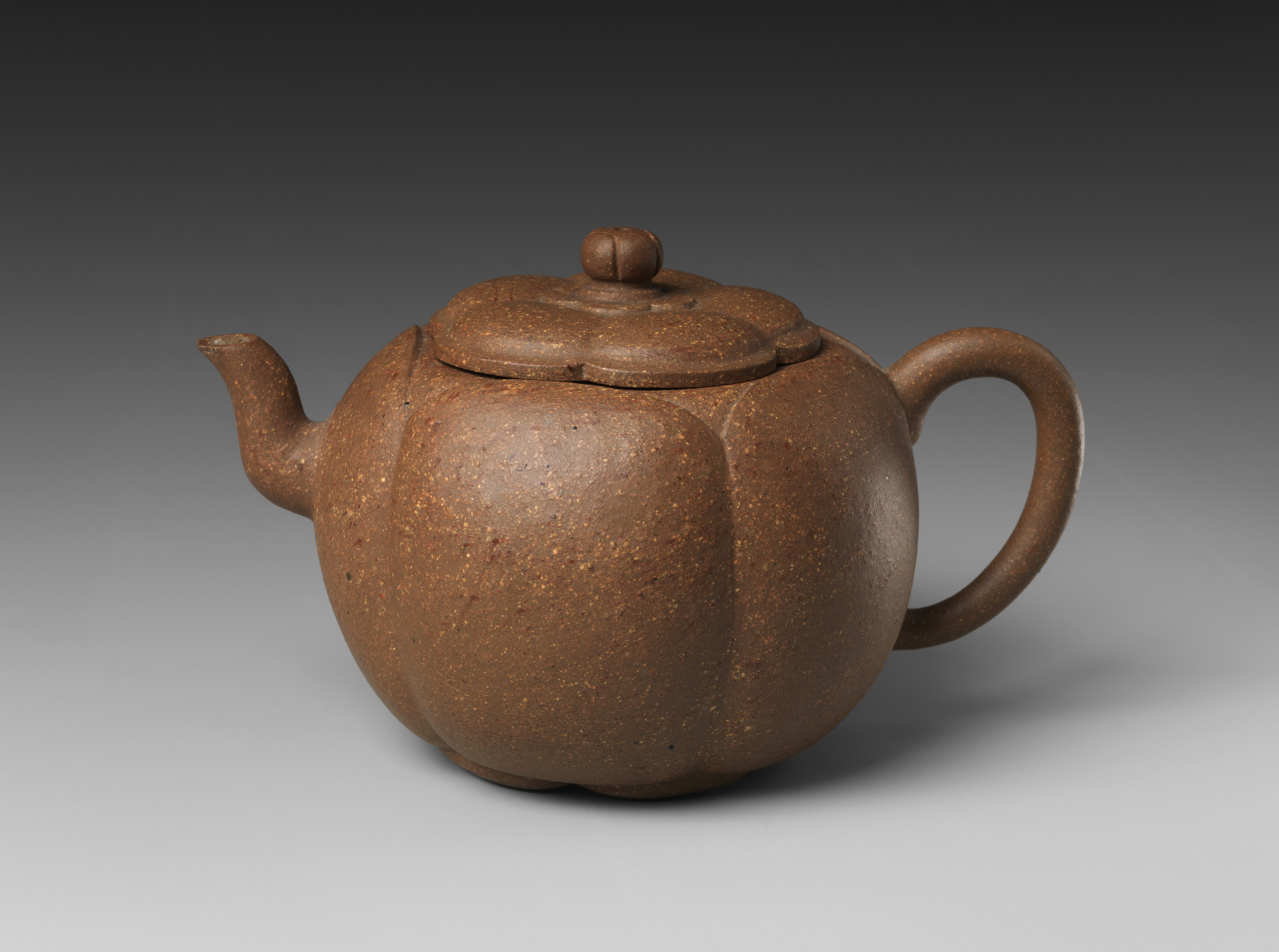
The Yixing teapot is at once a tool, a sculpture, a geological claim and a market full of stories. A close reading begins with what can be known: the clay, the making, the shape, the handling and the provenance.
A teapot made for leaves
The history of the Yixing teapot begins with a change in tea itself. By the sixteenth century, steeped loose leaves were displacing older preparations based on powdered tea. The new method called for a vessel that could hold expanding leaves, receive hot water and pour cleanly. Potters around Yixing, in Jiangsu province west of Lake Tai, developed an unglazed stoneware answer.
The familiar origin story names Gong Chun, a servant said to have learned the craft from a monk at Jinsha Temple. It is a beautiful story resting on precarious evidence. Recent research by archaeologists Xuyang Gao and Anke Hein connects the texts that established it to the Wu family, Gong Chun's supposed patrons. Their work shows how craft history grew through publishing, collecting, friendship and family reputation. Tea carried social capital, and the pot placed that capital in the hand.
Technical refinement in the workshops met the cultivated attention of literati who wrote about vessels, exchanged them and attached names to them. Yixing developed at this meeting point between workshop knowledge and self-fashioning.
What zisha actually describes
Zisha is often translated as "purple sand", a picturesque name for a group of iron-rich clay materials associated with the Yixing area. Historically extracted in and around Huanglong Mountain, they occur in distinct lenses within sedimentary strata. Raw material may appear red, purple or green before processing and firing; the finished body therefore ranges far beyond literal purple.
A 2019 study led by Jian Zhu used petrographic thin sections and neutron activation analysis to compare raw and fired clays from several collection areas. The groups had distinguishable trace-element and mineralogical profiles that remained broadly stable after traditional processing and firing. Laboratory provenance can draw on those signatures; colour and grain observed by a buyer cannot establish a mine, age or clay family with the same confidence.
Traditional preparation is laborious: extracted material is weathered, broken down, ground, sieved, mixed with water, rested and wedged into a workable body. Recipes and processing choices changed over time. Modern commercial names may refer to a mine, a geological layer, a recipe, a colour, a workshop convention or a seller's preferred vocabulary. A useful enquiry begins with the precise claim and the evidence offered for it.
A working map of clay language
The categories below provide a working vocabulary. Firing atmosphere, temperature, particle preparation, blending and additives can all alter the final appearance, so each name needs the context of a maker, recipe and firing.
| Family | Common fired range | Typical handling impression | What the name can tell us | Principal caution |
|---|---|---|---|---|
| Zini | Brown, aubergine, deep reddish brown | Often substantial, fine-grained to visibly textured | A broad purple-clay family in workshop and collector usage | Mine, age and purity require evidence beyond colour |
| Qingshuini | Usually warm brown to reddish brown | Often relatively even and restrained | Commonly treated as a zini-related prepared body | The term is used inconsistently across sellers and periods |
| Hongni | Red to orange-red | Can be smooth and relatively dense | A broad red-clay category | Red colour covers several bodies; historical hongni needs stronger attribution |
| Zhuni | Orange-red to saturated red | Often fine, dense and associated with greater shrinkage | A prized red body in collector language | Scarcity claims and visual tests are particularly vulnerable to exaggeration |
| Duanni | Buff, ochre, yellow-brown, grey-green | Frequently lighter in colour and visibly granular | A broad group of paler bodies and recipes | Modern blends and coloured bodies can imitate expected tones |
| Luni | Greenish or pale raw-clay association; fired results vary | Rarely meaningful without recipe and firing context | A historical colour term within the wider material vocabulary | Finished green colour alone provides weak evidence of natural luni |
The pot is built, not thrown
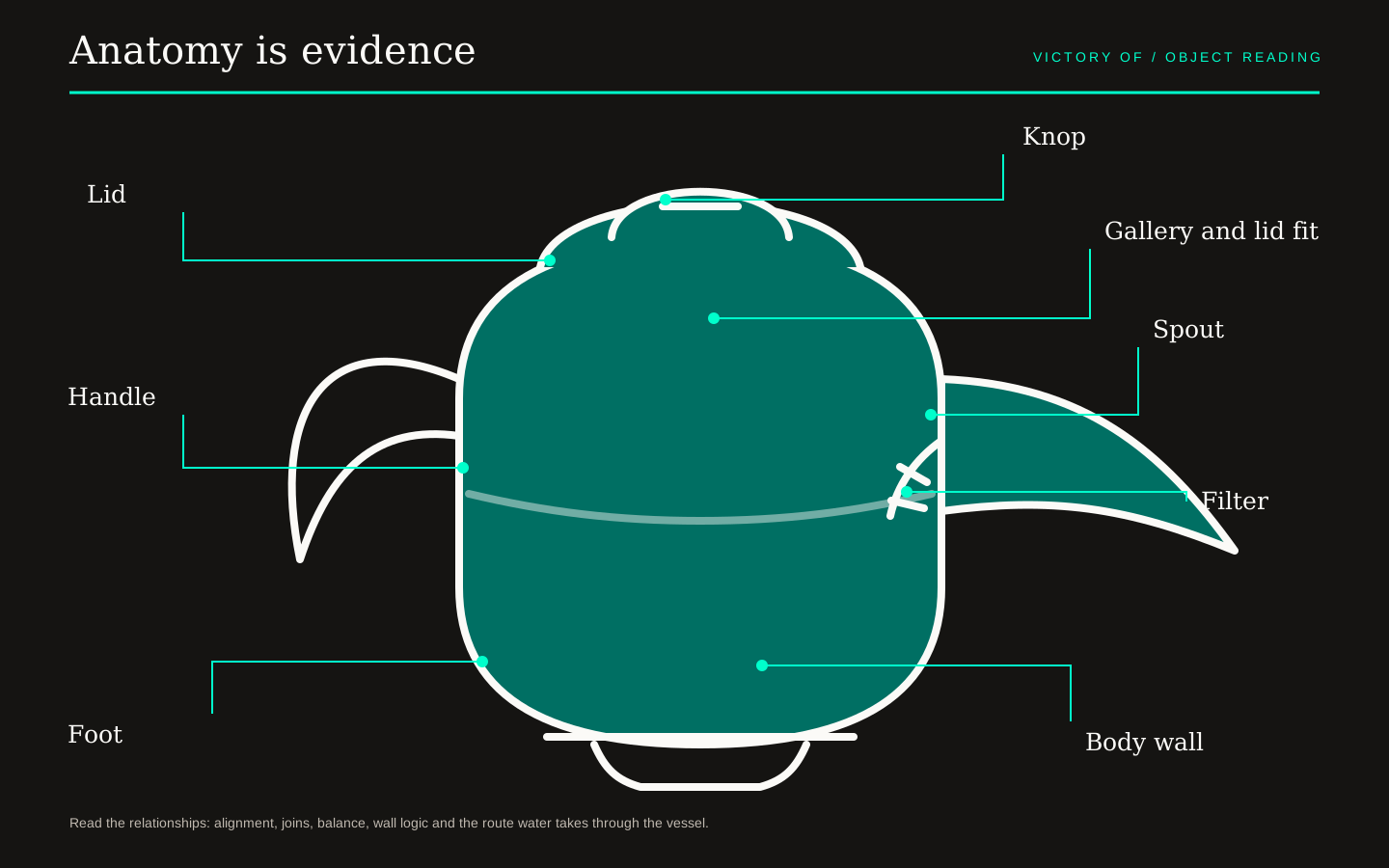
The canonical Yixing teapot is associated with slab building. A prepared clay body is beaten or rolled into sheets; components are cut, joined and refined. For a round body, a strip can be formed into a cylinder and beaten outward over an internal support. Angular bodies demand a different sequence of panels and joins. Spout, handle, lid and body must then be made to read as one object.
"Handmade" covers several very different levels of authorship. A fully hand-built pot may be formed without a production mould while still relying on templates and gauges. A half-handmade pot uses mould assistance for repeatability, followed by substantial hand assembly and finishing. Slip casting introduces liquid clay into a mould and follows a different production logic. Clear descriptions allow the buyer to appreciate the skill appropriate to each method.
| Method | Basic process | Variation between examples | Evidence worth examining | Interpretive limit |
|---|---|---|---|---|
| Full hand building | Slabs or beaten clay are cut, joined and refined individually | Usually meaningful, including subtle asymmetries | Join logic, interior construction, tool sequence, documented maker | Irregularity alone is inconclusive; skilled makers can work with great precision |
| Mould-assisted hand assembly | Components gain repeatable geometry from moulds, then are joined and finished | Moderate; finishing can be highly skilled | Repeated body geometry, seams, workshop documentation | Mould use describes process rather than quality or price |
| Slip casting | Liquid body forms against a mould wall | Low within a production run | Casting seams, uniform wall logic, production context | Smoothness and symmetry appear in several methods |
The most revealing test is functional. Does the handle balance the filled pot? Can a finger control the lid safely? Does the spout begin and end its pour without theatrical dripping? Does the opening admit the leaves the pot is meant to hold? A seal can be copied. A coherent relationship between hand, water and form is harder to counterfeit.
The grammar of form
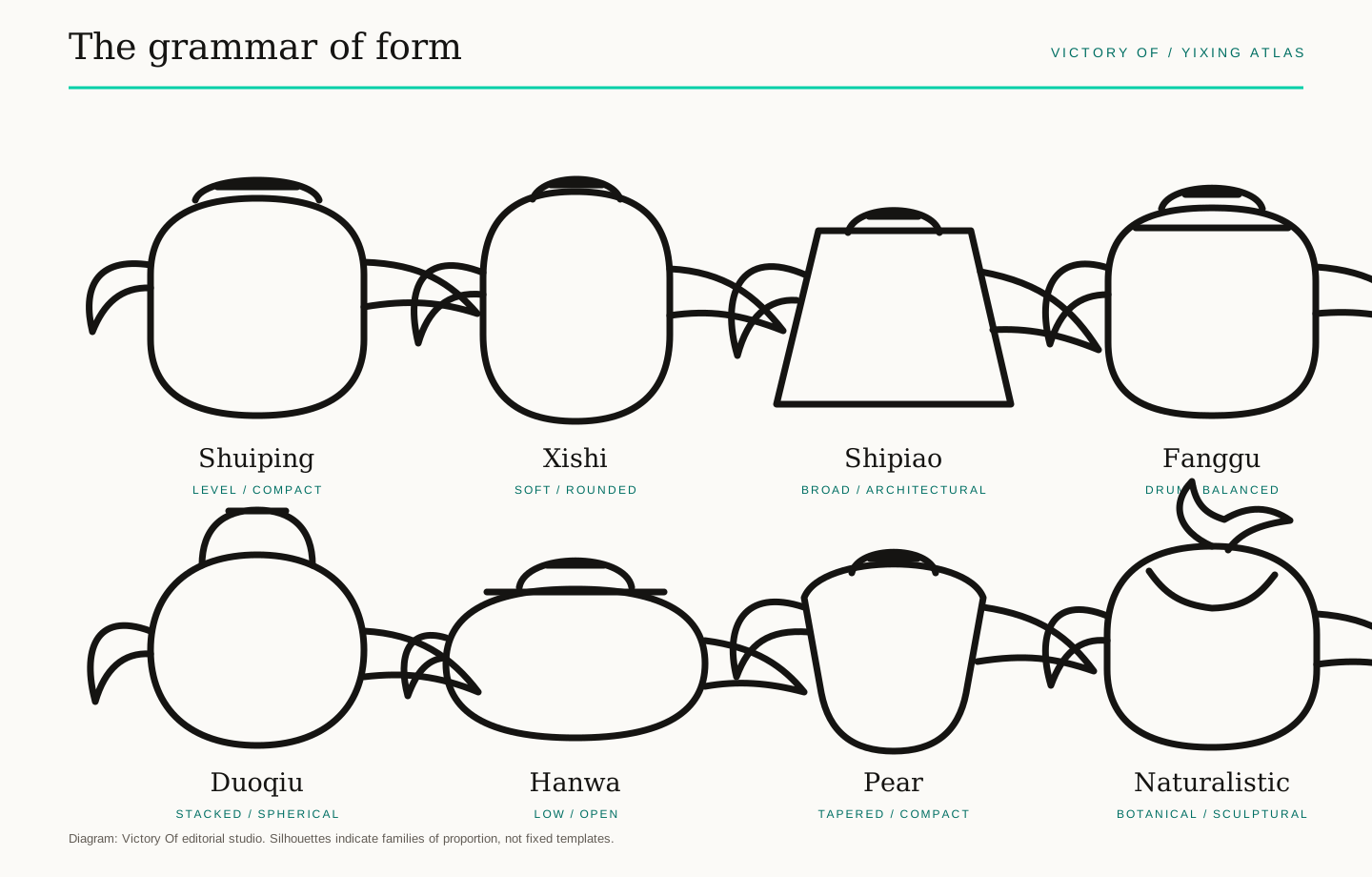
Yixing forms are often treated like a list of collectible names. It is more useful to read them as solutions to volume, heat, leaf expansion and movement. The table describes tendencies, not rules; wall thickness, scale and execution can matter more than the family name.
| Form | Geometry | Opening and leaf room | Thermal tendency | Practical character |
|---|---|---|---|---|
| Shuiping | Compact, level, rounded body with balanced horizontal axis | Usually moderate opening and even interior | Stable at small scale | Direct, controlled and well suited to repeated short infusions |
| Xishi | Softly rounded, compressed pear-like body | Moderate opening; curved interior gives leaves room | Rounded mass can retain heat well | Sensuous in the hand; quality depends heavily on handle and spout balance |
| Shipiao | Trapezoidal or pyramidal body with broad base | Often generous internal floor | Broad base distributes heat and leaves | Architectural, stable and especially revealing of slab control |
| Fanggu | Drum-like, rounded body with defined shoulders | Moderate to broad | Depends strongly on wall and scale | Formal and balanced, with a strong relationship between lid and body |
| Duoqiu | Stacked spherical volumes | Opening varies; interior can be generous | Compact volumes tend to hold heat | Sculptural continuity from body to lid is the central test |
| Hanwa | Low, broad, tile-like profile | Often broad opening | Lower body can release heat more readily | Accessible for larger leaves and visually severe |
| Pear form | Tapered upper body and fuller lower volume | Often narrower at the mouth | Compact and potentially heat-retentive | Historically widespread beyond a single workshop vocabulary |
| Naturalistic | Melon, lotus, bamboo, tree or fruit references | Governed by the model rather than a standard | Highly variable | Judge whether decoration serves the vessel rather than obstructing it |
Choosing a pot for the tea you actually drink
The useful match begins with leaf size, roasting, infusion speed and heat. Clay names remain secondary to volume, wall thickness, opening and pour. The table below offers practical starting points for gongfu brewing; it is a tasting map rather than a law.
| Tea and brewing aim | Useful pot character | Forms to examine | Starting volume | Why it tends to work |
|---|---|---|---|---|
| Yancha and other roasted Wuyi oolongs | Compact body, steady heat, decisive pour; medium or slightly thicker wall | Shuiping, Xishi, Duoqiu | 80-120 ml | Sustained heat supports repeated short infusions and the compact scale keeps the liquor concentrated |
| Dancong and highly aromatic oolongs | Fast pour, moderate or thinner wall, enough room for long twisted leaves | Shuiping, pear, a restrained Xishi | 80-110 ml | Responsive heat control helps preserve fragrance and reduces the risk of stewing delicate high notes |
| Rolled Anxi or Taiwanese oolongs | Rounded interior with room for the leaves to unfurl; medium opening | Xishi, Fanggu, Duoqiu | 100-150 ml | A generous internal volume accommodates expanding pellets without requiring an oversized pot |
| Sheng pu-erh, especially young or fragrant examples | Quick, clean pour; moderate heat retention; broad access for compressed leaf | Shipiao, Hanwa, Shuiping | 90-140 ml | Control over contact time can keep bitterness and astringency articulate rather than blunt |
| Shou pu-erh and aged dark tea | Stable heat, comfortable opening and filter, medium to thicker wall | Fanggu, Duoqiu, Xishi | 100-160 ml | Heat supports extraction while the wider opening makes dense or broken material easier to load and clear |
| Black tea and heavily oxidised oolong | Balanced rounded body, moderate wall, smooth medium-speed pour | Xishi, pear, Fanggu | 100-150 ml | The forgiving geometry suits rich infusions without demanding extreme heat or very fast handling |
| Green, white and very delicate teas | Thin wall, broad opening and lower profile; often porcelain is the clearer first choice | Hanwa or a small thin-walled Shipiao | 100-150 ml | Rapid cooling and visual access help protect tender leaves from excess heat |
For a first working pot, start with the tea brewed most often and choose a modest capacity that matches the number of drinkers. Test the empty balance, then ask to see a full pour: the stream should begin promptly, remain coherent and stop without a long tail of drips. A broad lid makes large leaves easier to place and remove. A multi-hole filter is helpful with broken pu-erh; a simple single hole can pour beautifully with intact oolong leaves.
Dedicated use is most useful at the level of broad tea families. One pot for roasted oolongs and another for fragrant, lightly oxidised teas is a workable distinction. Maintaining a separate vessel for every mountain, cultivar or vintage usually adds ceremony faster than insight. Sensory claims that a named clay automatically "sweetens" tea or removes undesirable notes deserve testing alongside neutral porcelain, using the same water, leaf weight, temperature and infusion time.
Attribution: an evidence ladder
The market encourages a detective fantasy in which a seal, a certificate and a few tool marks reveal everything. Serious attribution proceeds more patiently, building confidence from several kinds of evidence.
- Documented provenance. A continuous collecting and publication history carries more weight than a newly supplied story.
- Contemporary documentation. Exhibition records, workshop archives, invoices and correspondence can connect object, maker and date.
- Technological coherence. Construction, material and firing should fit the proposed period and workshop practice.
- Comparative study. Shape, inscriptions, seals and workmanship should be compared with securely attributed examples.
- Materials analysis. Chemical and mineralogical testing can support or challenge provenance claims, although it rarely supplies a maker's name by itself.
- Marks and certificates. These become persuasive when embedded in stronger documentation and remain weak in isolation.
- Seller language. Phrases such as "old mine", "master clay" and exact storage-age claims are prompts for further questions.
The British Museum's records offer a salutary example. One red stoneware pot with European gilt mounts is catalogued with an explicit note that a scholar has questioned whether the body is Chinese. The uncertainty is part of the object's history. A responsible catalogue does not improve a story merely to make it easier to sell.
Living with a pot
Rinse a new pot with clean water, inspect it for dust or residue and begin gently. Avoid detergents or scented products on an unglazed body unless a conservator or maker gives a specific reason. Empty the leaves after use, rinse, and let every component dry fully before enclosed storage.
Regular use with a broad family of tea gradually gives the surface a quiet lustre. Clean practice matters more than aggressive "seasoning" rituals: accumulated oil and stale moisture obscure the material, while patient handling allows a natural patina to develop.
Three ways to buy
The first serious pot should be bought for proportion, comfort and pour. Choose a scale that fits an actual brewing habit. Ask who made it, how it was formed and what the clay description means, then notice whether the answers are specific and consistent.
The study object may be modest but should teach something: a clearly shown construction method, a well-documented contemporary workshop, an unusual form or a material claim accompanied by evidence. Its value lies in comparison.
The historically important work demands provenance before romance. Maker, date, publication history, condition, repairs and scientific analysis may all matter. At this level, independent expertise and collection records are not optional extras.
The Yixing teapot rewards patience. It is geology transformed by labour, an instrument measured in seconds, a vehicle for names and reputations, and a small architecture designed to disappear into the act of making tea. The finest examples hold their appeal in the exact fit between material, form and use.
Sources and image rights
The Metropolitan Museum of Art object record (hero image: Public Domain, Open Access); British Museum collection records Franks.2459, 1888,0913.18 and 1927,0219.1; Hong Kong Museum of Art / Flagstaff House Museum of Tea Ware, K.S. Lo Collection; Jian Zhu et al., Microchemical Journal 147 (2019); Xuyang Gao and Anke Hein (2024). Museum objects whose reproduction rights were not explicit were used as research sources only, not republished.