Switzerland had 13,984 charitable foundations on its commercial register at the end of 2025, including 202 marked as being in liquidation. Their combined assets were estimated at CHF 159.6 billion. Those figures suggest considerable financial weight, but they say little about how much of that capital can be committed to a particular problem, or how often it can be used. A section of the Swiss Foundation Report 2026 explores a question now being discussed more openly among grantmakers: what happens when a foundation finances an organisation in ways that may bring the money back, attract another funder, or allow a project to begin without paying out the full sum at once?
The report calls this unternehmerische Foerderung, roughly entrepreneurial or enterprise-style philanthropy. It concerns the distribution of charitable funds, rather than the investment of a foundation's endowment. In practical terms, the instruments include repayable loans, guarantees, participation in an enterprise, and matching funds. They serve different purposes and carry different risks. A foundation considering them still has to begin with its charitable purpose and the needs of the organisation it supports.
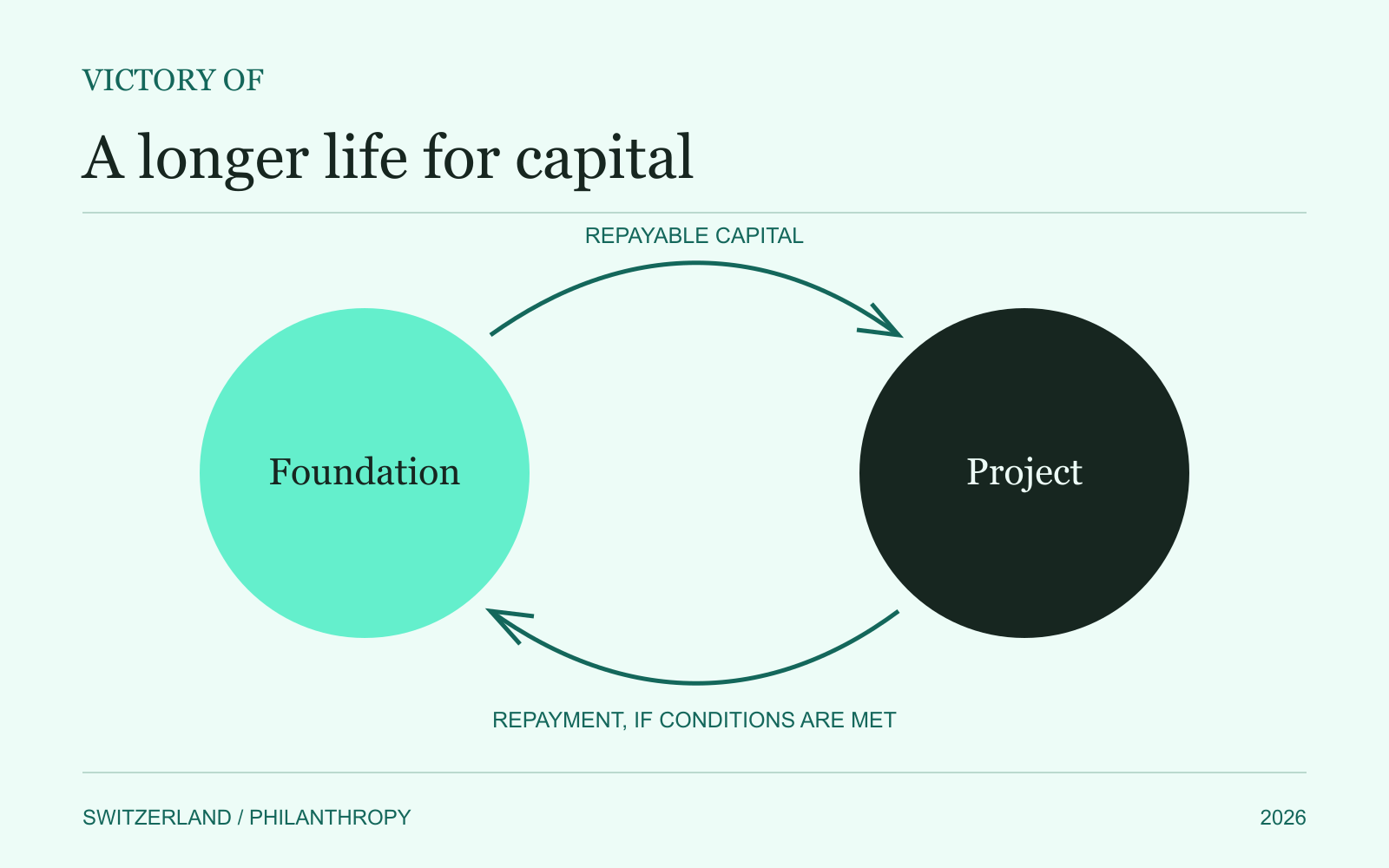
Consider the example in the report of a Swiss foundation supplying time-limited start-up capital to a hospital in Kenya. The financing is tied to coaching, impact objectives and operational milestones. If the hospital reaches those milestones and achieves a positive operating result, the capital can later be repaid. The arrangement gives the hospital room to build capacity while allowing the foundation, if repayment occurs, to deploy the same money again. Its success depends on the hospital's ability to generate a reliable surplus; a loan that crowds out patient care would defeat the charitable purpose.
A second example uses a different logic. A foundation guarantees a deficit for a Swiss nonprofit developing a childcare service. The promise gives the organisation confidence to proceed with a planned budget, while the foundation pays only if the shortfall actually materialises. The value of the commitment lies partly in making the service possible before the money is spent. The foundation, however, must be prepared to honour the guarantee when it is called.
Matching funds work differently again. A foundation pledges to match contributions from other donors, usually up to a stated ceiling. The arrangement can enlarge the funding pool and give a project a deadline or a clear target. Unless the underlying grant has separate repayment terms, those matching contributions do not return to the foundation. The Swiss report says matching funds are the most frequently used of the enterprise-style instruments in its survey: around half of the 70 participating grantmaking foundations already employ them.
| Instrument | What the foundation commits | What may come back | Principal risk |
|---|---|---|---|
| Repayable start-up capital | Cash for a defined period and purpose | Principal, if repayment conditions are met | The recipient cannot repay without harming its work |
| Deficit guarantee | A promise to cover an agreed shortfall | No repayment is inherent; the guarantee may never be drawn | The shortfall arises and the foundation must pay |
| Matching fund | A contribution conditional on other gifts | Usually no financial return | The campaign attracts too little new support |
The distinction matters. "More impact per franc" can mean reusing repaid capital, mobilising additional donors, or making a service viable with a contingent commitment. These are not interchangeable outcomes, and a foundation should be able to say which one it is seeking.
The survey behind the report also shows why adoption has been cautious. Conducted by the University of Basel's Center for Philanthropy Studies for UBS Social Impact and Philanthropy, it gathered responses from 70 Swiss grantmaking foundations. Roughly half said they were engaging strongly or fairly strongly with entrepreneurial philanthropy; the other half were barely engaging with it or not at all. Repayable loans were widely known but less often used than matching funds. Respondents pointed to uneven cantonal tax interpretations, accounting questions, limited internal expertise and a reluctance to take on additional risk. The authors explicitly caution that the survey is not statistically representative of the entire Swiss foundation sector.
Zurich's more accommodating approach to the tax treatment of entrepreneurial philanthropy has helped reopen the discussion, according to the report. Yet a foundation cannot treat a favourable climate as a substitute for legal and financial design. It must know how the instrument fits its governing purpose, how a possible loss will be accounted for, and who will monitor the recipient. In a lean sector, that last question has force: the report says only 18.3% of Swiss foundations have a registered executive management function. Many boards already perform operational work themselves.
The report points to Britain's Venturesome Impact Fund as an illustration of capital being used repeatedly. Since 2002, it says, the fund has supported more than 700 projects with loans totalling GBP 60 million, while deploying GBP 20 million over that period. That is a useful example of a revolving approach, though it does not establish that every loan was repaid or that every project achieved its intended social result. The larger question for Swiss foundations is which organisations genuinely benefit from such terms. A service with predictable income may be able to carry a carefully structured loan. Emergency relief, independent journalism or early-stage research may need the freedom of an outright grant.
The emerging model is therefore a matter of fit rather than fashion. A foundation can choose a grant where financial return would distort the work, a guarantee where uncertainty is holding back a viable service, or repayable capital where future revenue makes recycling possible. The sophistication lies in allocating risk consciously and leaving the recipient strong enough to pursue the purpose for which the funding was offered.