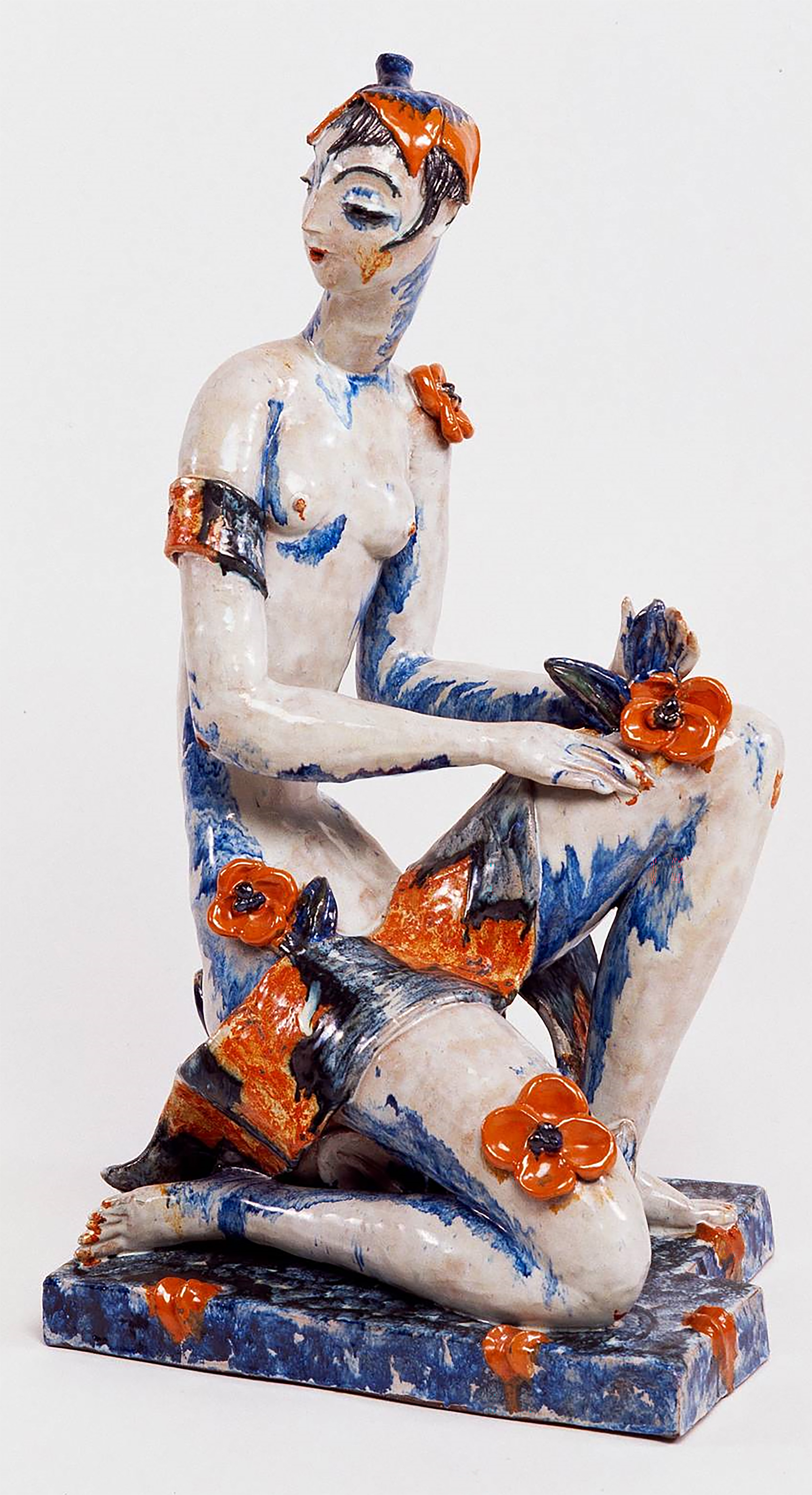
The most useful place to begin with Vally Wieselthier may be the line that separates the clay from its finish. In the MAK's press catalogue, the Group of figures of 1917 is described as red biscuit glazed in white and blue. Flora, made in 1928, is likewise red biscuit, this time with a multicoloured glaze. The entry for Salome, made in New York around 1938, changes vocabulary: painted clay with gold decoration. The three works are separated by two decades, yet their catalogue entries pose the same question: how much of a sculpture's character belongs to the substance that holds its shape, and how much is created by what happens at its surface?
What a catalogue can tell us
The red body named in the first two entries is a material fact. A claim about where the artist deliberately left it exposed, whether a glaze was applied in a particular order, or how a colour changed in the kiln requires more evidence. A photograph may show a line between two colours. It cannot necessarily tell us whether the line records the edge of a brushstroke, a movement of glaze in firing, or a later intervention. That distinction is where an account of making becomes more interesting than a list of techniques.
The Group of figures offers a narrow palette through which to pursue the question. Where white and blue cross the boundaries between figures, do they make several bodies read together? Where the colours separate, does the surface draw distinctions the modelling leaves ambiguous? Flora puts a more complex palette to work on a single seated figure. The comparison is worth making precisely because the catalogue describes a similar ceramic body in both cases. It shifts attention from identifying what the work is made of to examining what an artist can do differently with a related material.
Clay in a room
The MAK also lists a fireplace casing, dated around 1925, in red biscuit with multicoloured glaze. Its presence changes the scale of the inquiry. The surface of a figure can be followed as the eye moves around it. A fireplace surround must also be read as part of a wall and in relation to the opening it frames. Colour here has a potential architectural task: a repeated accent can join parts across a distance, or make the transition from object to room more emphatic. The museum also lists a drawing for a fireplace casing from around 1927. The dates alone give no reason to treat that drawing as the preparatory design for this particular object. Read side by side, they instead offer two kinds of evidence about the same problem: how a coloured surface is planned on paper and how it is made to occupy architectural space.
The New York comparison
Salome makes the most productive comparison with Flora. Both are figures, yet the later work's catalogue entry does not describe a multicoloured glaze. It describes paint and gold decoration. A change in the vocabulary of finishing is worth noticing even when the available record does not explain it. What would paint allow Wieselthier to control at the surface? How did the gold alter the work under light? Do the museum's records tell us which materials, facilities or collaborators were available to her in New York? These are questions to put to the objects and their conservators, not a ready-made story about how a move across the Atlantic changed her practice.
The distinction between glaze and paint also changes the questions we can ask of an image. A glaze is fused in firing, and its final appearance depends on more than the colour that went onto the clay. The catalogue's description of painted clay and gold on Salome does not tell us the binder, how the gold was applied, or whether any of the decoration was fired. The most useful photograph would show a boundary between finishes, or an underside where the treatment stops. That is where a reader could see the evidence for a claim about making, rather than take the finished colour as its own explanation.
The retrospective makes it possible to look at Wieselthier's work on a scale that an account of style often misses. At one distance a figure declares its silhouette; closer to the surface, colour can divide that silhouette into a different set of parts. It is between those two distances that clay, glaze and paint become a way of thinking in sculpture.