The city behind the name
Tokyo Gendai takes its name from the capital while unfolding in Yokohama, a separate port city in Kanagawa, about 25 kilometres south-west of central Tokyo. That distinction gives the fair much of its character. Yokohama opened to international trade in 1859 and developed as one of Japan’s principal points of exchange with the outside world. Photography studios, foreign settlements, shipping companies and new forms of urban life appeared here early, leaving the city with a cultural memory shaped by movement across borders.
PACIFICO Yokohama stands on the waterfront in Minato Mirai 21, a planned district built over former shipyards. The polished skyline rises beside docks, warehouses and converted buildings that preserve the industrial pattern of the port. The nearby Yokohama Museum of Art, designed by Kenzo Tange and reopened after renovation in 2025, anchors the district with a collection of more than 15,000 works and a particular strength in modern and contemporary art and photography.
Yokohama’s contemporary culture has also grown through projects that use the city itself as material. BankART1929 began in a former bank and later occupied shipping warehouses, studios and temporary sites across the waterfront; the Yokohama Triennale has similarly connected museums with port architecture and public space. Tokyo Gendai arrives within this civic history of reuse and international exchange. The fair’s mix of Tokyo galleries, regional Japanese practices and exhibitors from Seoul, Taipei, Bangkok, Auckland and Latin America reads as an extension of the port city around it.
How to read the floor
The fourth Tokyo Gendai is organised across five registers. Galleries provides the broad survey; Hana focuses on early- and mid-career practices; Eda gives space to established and historically significant artists. Miki, new for 2026, is devoted to paper, photography and print. Tane returns after two years with digital media, film, animation, augmented and virtual reality and gaming.
The main Galleries sector includes Pace Gallery (New York, Los Angeles, London, Geneva, Berlin, Seoul and Tokyo), Sadie Coles HQ (London), Taka Ishii Gallery (Tokyo, Kyoto and Maebashi), TARO NASU (Tokyo), Gana Art (Seoul and Los Angeles), Ceysson & Bénétière (Saint-Étienne, Luxembourg, Paris, Geneva, New York, Lyon, Panéry and Tokyo), KOTARO NUKAGA (Tokyo), The Page Gallery (Seoul), space Un (Tokyo) and A Lighthouse called Kanata (Tokyo). The locations clarify the sector’s balance: a strong Japanese core sits beside galleries with networks across Europe, the United States and Korea.
Hana includes Lett Thomas (Auckland), CON_ (Tokyo), Yoshiaki Inoue Gallery (Osaka), Yutaka Kikutake Gallery (Tokyo) and W—Galería (Buenos Aires and Pueblo Garzón). Eda brings together Ippodo Gallery Tokyo (Tokyo) and MIZOE ART GALLERY (Tokyo and Fukuoka). The first Miki presentation includes BANGKOK CITYCITY GALLERY (Bangkok) and Revolver Galería (Buenos Aires and Lima). Tane’s digital programme features TAEX (London), Chi-Wen, Project Fulfill Art Space and Double Square Gallery (all Taipei), together with Takuro Someya Contemporary Art (Tokyo).
Where to slow down
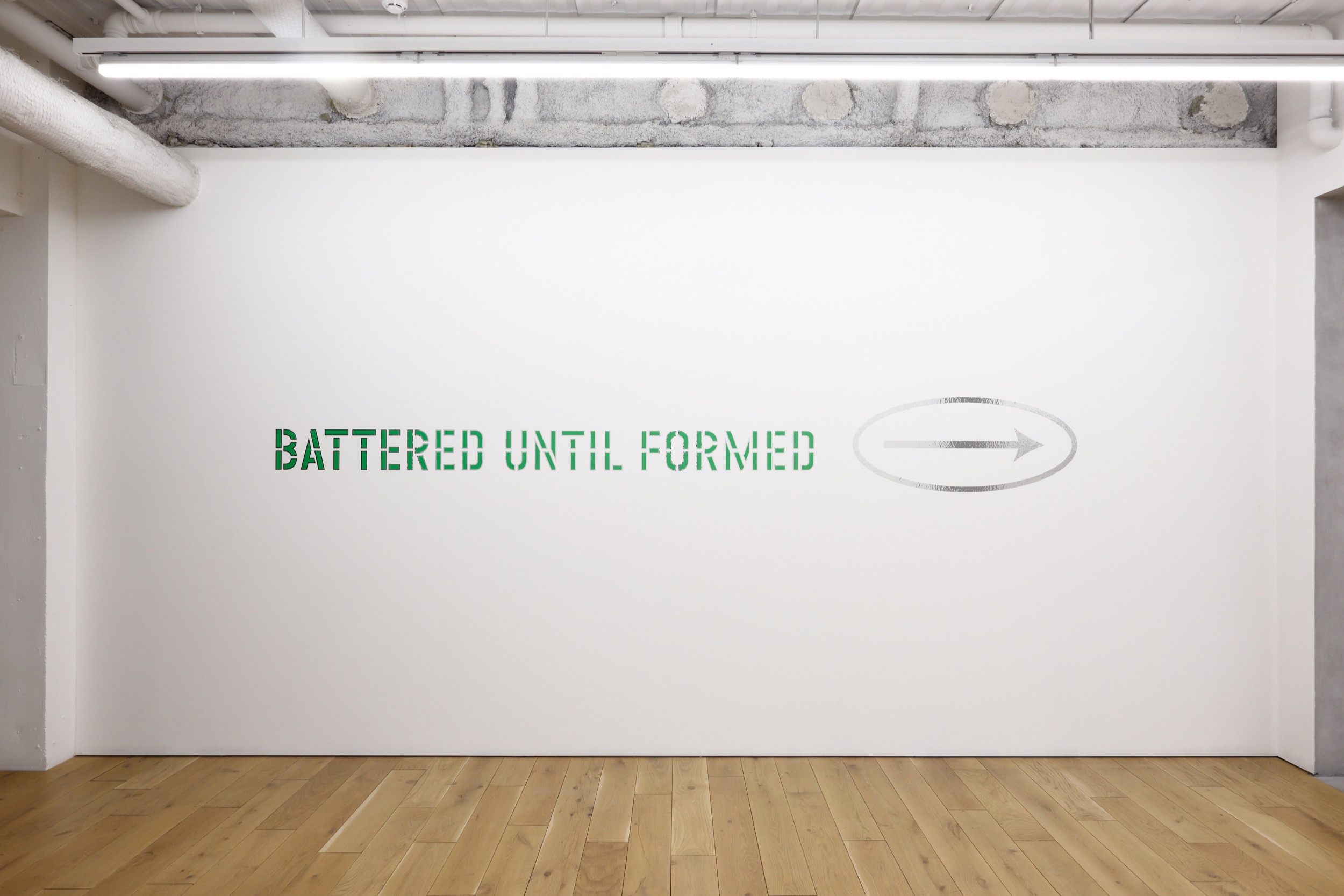
Sato, the fair’s installation and performance programme, brings together three distinct approaches to space. Marina Abramović presents Slow Walking (2026), an avatar performance on a monumental LED wall. Lawrence Weiner’s BATTERED UNTIL FORMED (2001), presented by TARO NASU, treats language as sculptural material: the words and arrow alter the way a viewer reads the wall, the room and the act of moving through it.
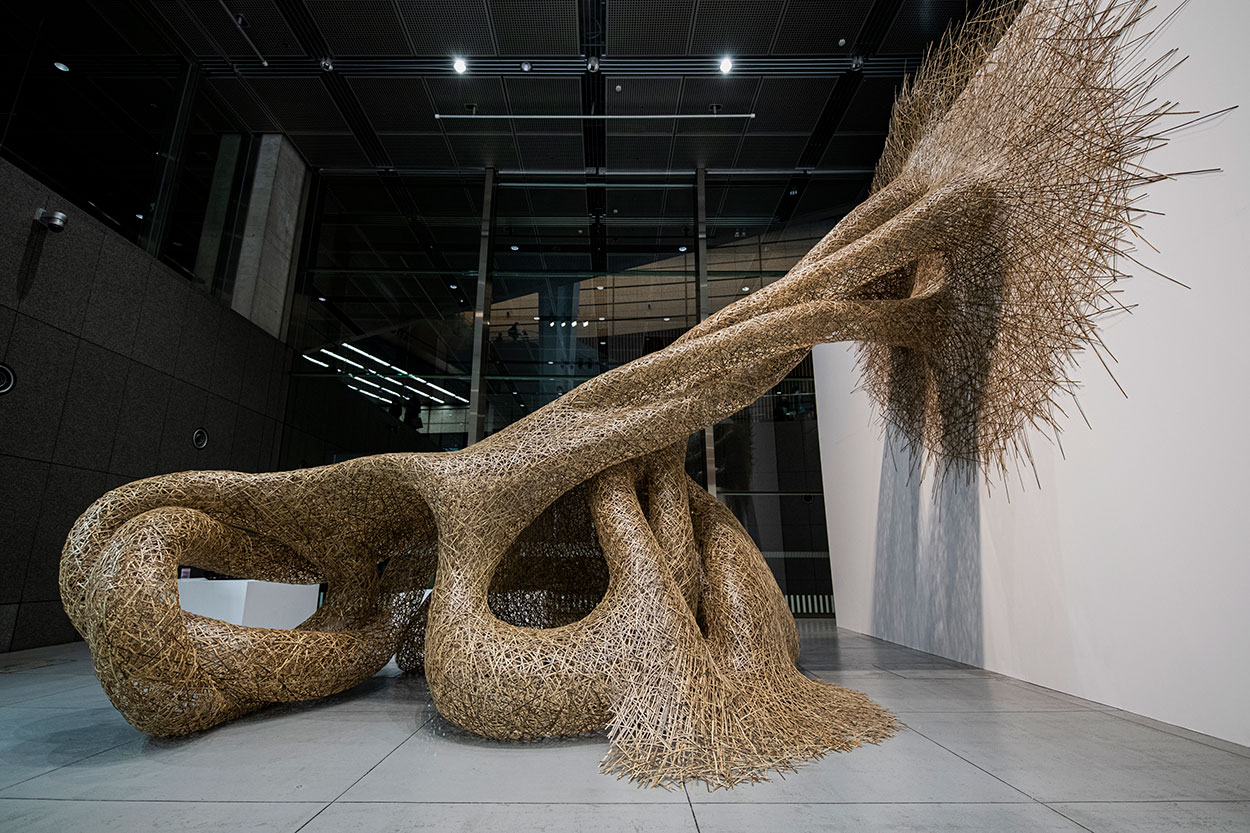
Tanabe Chikuunsai IV, a fourth-generation bamboo artist from Sakai, presents Circulation (2023) with YUMEKOUBOU Gallery. His large installations are woven from tiger bamboo into fluid structures that appear to grow through architecture. The nearby image shows Recirculation, an earlier installation from the same body of work, and makes the physical scale and density of his method visible before the fair.
The fair beyond its booths
Sato supplies much of the fair’s movement and sound. Shohei Takasaki will make a live painting with improvised percussion by Seiya Kudo during the vernissage. Soh Souen’s performance The Egg asks participants to negotiate care, fragility and the space between bodies. Ryuichi Ohira’s The Time Signal interrupts the hall at irregular moments, while a four-artist installation from MtK Contemporary Art works with natural forces that remain beyond human control.
The visual register moves freely between seriousness and spectacle. Mr. has transformed a Toyota Soarer, the aspirational Japanese grand tourer of the 1980s and 1990s, into a large sculptural work for Kaikai Kiki Gallery. Qin Feng extends the language of Chinese experimental ink; Syozo Taniguchi translates his enigmatic houses and animals into sculpture; Takeshi Yasura’s Garden considers the metabolism of a city through continuities between living and inorganic matter. These projects should give the hall a rhythm of encounters, interruptions and changes in scale.
Two awards add another way to read the fair. The Hana Artist Award focuses attention on an artist approaching wider international recognition, selected by curator and writer Elisa Carollo, Mori Art Museum senior curator Taku Tokuyama and collector Monique Long. Los Angeles artist Umar Rashid, winner of the 2026 AMA Artist Award, presents a new commission made for Tokyo Gendai. Together they shift some attention from established market names towards practices still building their international histories.
Yokohama becomes part of the programme
The parallel programme extends across the city under the name Yokohama Art Voyage from 10 to 14 September. A free shuttle links PACIFICO Yokohama with the Yokohama Museum of Art, Art Center NEW, the Koganecho and Hinodecho district, Zou-no-Hana Terrace, ExPLOT Studio and BankPark YOKOHAMA. The programme includes open studios, live demonstrations, craft workshops and projects that use streets and public spaces as their stage.
This changes the scale of a visit. The convention hall offers the concentrated commercial view; the shuttle route opens onto institutions, artist-run spaces and neighbourhoods shaped by the port. Koganecho, once known for tiny bars and an illicit economy beneath the railway tracks, has developed a network of studios and cultural spaces. Zou-no-Hana sits on the waterfront between the old customs district and the harbour. Moving between them makes the city’s cycles of trade, redevelopment and cultural reuse visible.
A full day can begin with the principal gallery sector while attention is fresh, continue through Hana and the new paper-focused Miki, and end with Sato’s installations and performances. A second day belongs to Art Voyage and the Yokohama Museum of Art. Visitors staying in Tokyo can treat Yokohama as a day trip, although the evening waterfront and the dispersed programme reward a slower stay.
Practical intelligence
Friday’s extended opening runs until 8pm. Saturday is likely to be the densest day; Sunday closes at 5pm. The online catalogue gives indicative prices for selected works, but it is not exhaustive and final availability and tax remain with each gallery.
The broader signal
Tokyo Gendai’s mixture of local depth and regional exchange matters more than a simple count of international exhibitors. The return of Tane and the creation of Miki place technological experimentation beside traditions of paper and image-making, allowing the fair to describe contemporary Asia through media as well as geography.
Sources and further reading
- Tokyo Gendai exhibitors and sectors
- Tokyo Gendai tickets and hours
- Sato programme
- Yokohama Museum of Art: architecture and Minato Mirai
- Yokohama Museum of Art: collection and history
- BankART1929: art and urban renewal in Yokohama
- Tokyo Gendai 2026 public programme
- Tokyo Gendai partner activations and Yokohama Art Voyage
- Lawrence Weiner: BATTERED UNTIL FORMED, TARO NASU
- Tanabe Chikuunsai IV: installations, YUMEKOUBOU Gallery