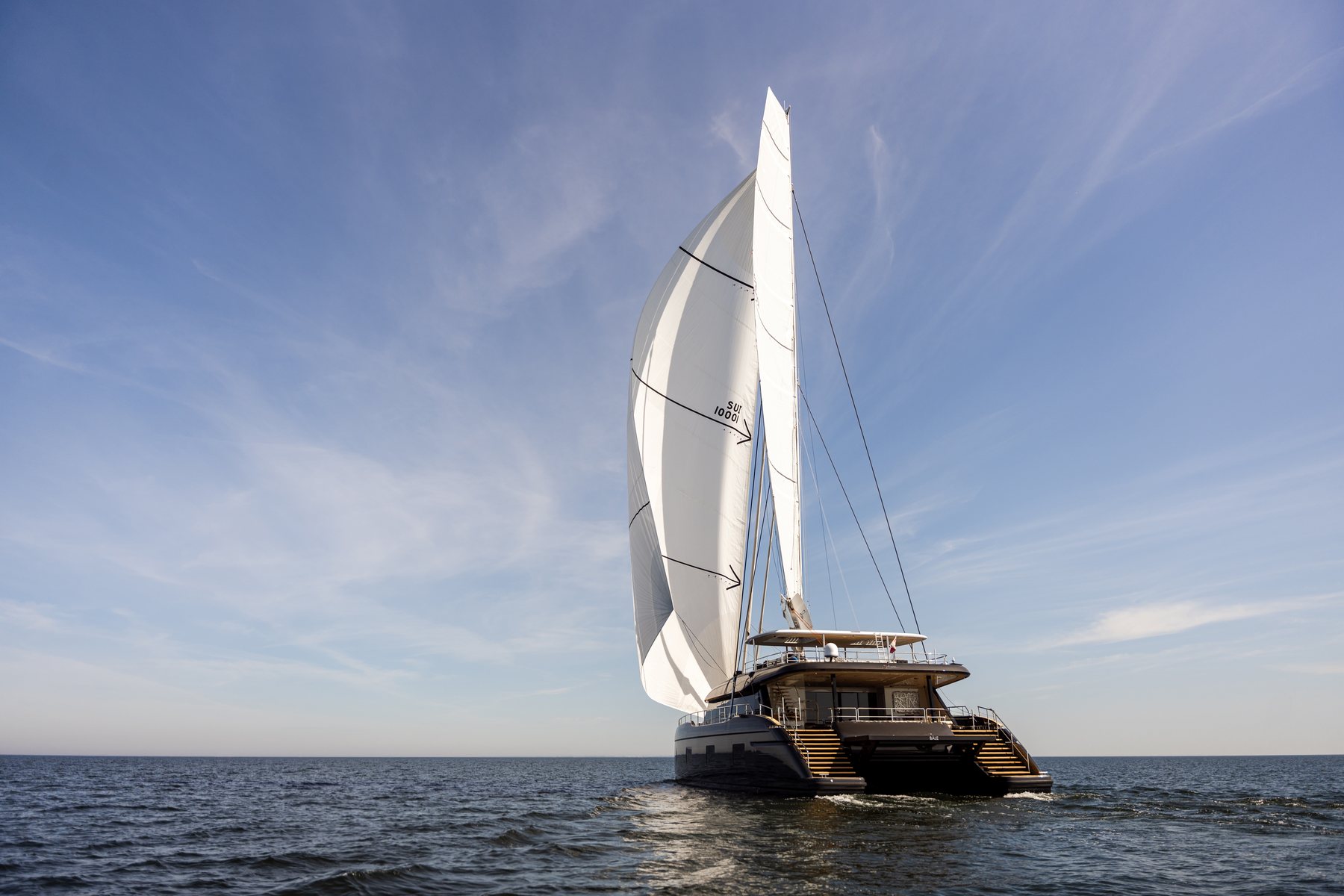
Electric yachting is entering a more serious phase. The early conversation was dominated by novelty: silent manoeuvring, solar panels and the promise of lower emissions. A buyer now needs a more exact vocabulary. Battery capacity, hotel load, propulsion demand, charging sources and passage profile matter more than a single sustainability label.
Ipharra, the first Sunreef 100 Eco sailing catamaran, is a useful case study because the yacht combines several systems rather than pretending that one technology solves every operating condition.
The architecture
The yacht carries 252 square metres of solar panels rated at 49 kWp and a 770 kWh battery bank. Electric propulsion is provided by two 360 kW units. Charging can come from the photovoltaic system, shore power, a range extender and hydrogeneration. Sunreef says regeneration becomes available above eight knots under sail.
That combination matters. Solar can support the continuous hotel load and contribute to charging, but a 30-metre yacht's propulsion requirement can rise far beyond what panels alone produce. Sails provide the primary low-energy passage mode; batteries make quiet electric operation possible; hydrogeneration recovers energy while sailing; the range extender remains a reserve for longer or less favourable operating patterns.
Where the system makes sense
Nicolas Lapp, Sunreef Yachts' CTO and cofounder, points to island hopping as the clearest use case. Short passages can be made under electric power, while longer crossings place more emphasis on sail and reserve generation. This is less a universal replacement for diesel than an integrated energy strategy suited to owners who can align route planning with the yacht's strengths.
The ownership proposition is also operational. Electric propulsion has fewer moving parts than a conventional diesel arrangement, potentially reducing routine mechanical service. The trade-off is a new layer of specialist knowledge: crew need to understand battery management, charging, energy budgets and the interaction between propulsion and hotel demand.
The due-diligence questions
A serious comparison should begin with measured operating data, not installed capacity. Ask for energy consumption at several speeds, generation under representative sunlight, regeneration at different sailing speeds, hotel-load autonomy in warm climates and the fuel consumption of the range extender. Ask how those figures change as the battery ages.
Warranty terms, battery chemistry, thermal-management design, inspection intervals and replacement assumptions are equally important. Victory Of requested those details, together with verified sea-trial data; Sunreef has not yet supplied publishable answers. Their absence does not negate the architecture, but it prevents a complete total-cost or autonomy comparison.
Sunreef's claim that solar can cover the full hotel load in favourable conditions is a manufacturer statement. It should be tested against climate, guest use, air-conditioning demand and measured operating logs.
A yacht with a second purpose
The owners intend Ipharra to continue educational activities associated with a Swiss boarding school. At their request, the school is not identified. This purpose gives the yacht an unusually relevant context: an advanced energy system becomes not only an ownership choice but also a platform through which future users can understand trade-offs between comfort, range and renewable generation.
The buyer's conclusion
The important innovation is not a claim of unlimited solar cruising. It is the orchestration of multiple sources around a large sailing platform. For an owner whose use is compatible with sailing, short electric passages and disciplined energy management, the result can reduce generator hours, noise and fuel dependence. For high-speed schedules, long motoring legs or inflexible itineraries, hybrid reserve capacity remains central.
The next step for this market is transparency. Buyers should expect standardised sea-trial tables, seasonal energy models and lifecycle information for batteries just as they expect range and consumption figures from conventional yachts. Ipharra shows what the hardware can look like. The industry's credibility will depend on the quality of the operating evidence that follows.