What the Kunsthaus Zürich 2027 Programme Is Really Building
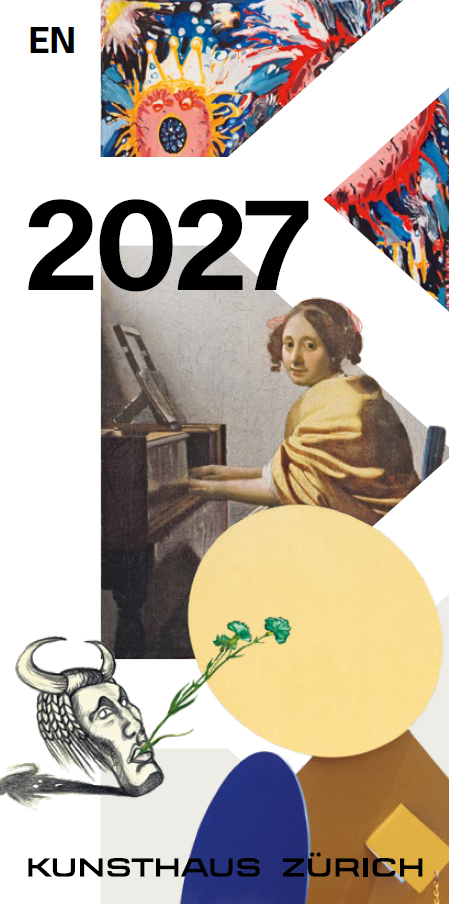
A museum programme can be a list of names, or it can be an argument. Kunsthaus Zürich’s 2027 calendar is most interesting as the latter: a deliberate movement between historical authority and contemporary friction, between painting as a durable medium and performance as an event that cannot be collected in quite the same way.
The year brings together Enrico David and Judith Bernstein from 12 February to 20 June; a one-day performance by Selma Selman on 6 March; House of Nisaba: New Stories of Painting from 9 April to 1 August; Wael Shawky from 23 April to 22 August; Claes Oldenburg from 8 October 2027 to 12 March 2028; and Rembrandt and his Circle, drawn from the Leiden Collection, from 22 October 2027 to 16 January 2028. The range is wide, but it is not random.
Painting after the common image
The pivotal exhibition may be House of Nisaba. Named after the Mesopotamian goddess associated with writing, knowledge and storytelling, it asks what painting can do in a culture where images circulate continuously and shared symbols have fractured into individual meanings. Nearly 35 artists are creating new works for the exhibition, with participants including Soufiane Ababri, Michael Armitage, Omar Ba, Nicole Eisenman, Hamishi Farah, Jill Mulleady, Cinga Samson, Selma Selman, Mounira Al Solh and Salman Toor.
This is more than a familiar declaration that painting is alive. The stronger proposition is that painting has become a technology of narrative selection. Mythology, film, literature, social media and popular culture are not presented as separate influences; they are the common visual weather through which artists now construct private iconographies. Formafantasma’s exhibition architecture should make that question spatial as well as pictorial, while the collaboration with Moderna Museet gives the project an institutional life beyond Zürich.
Performance as an economy of memory
Selma Selman’s performance makes the programme’s concern with value unusually literal. At its centre is the dismantling of a Mercedes-Benz S-Class that the artist gave her father for his 60th birthday and later inherited after his death. The car moves through several states: an emblem of mobility and emancipation, a family possession, an object of mourning, raw material and, eventually, art.
The work matters because it refuses a clean division between cultural and economic value. Selman has long used discarded vehicles and satellite dishes as surfaces carrying personal and social histories. Here, dismantling becomes a transitional ritual, accompanied by opera singer Nataša Tasić Knežević, sound artist Dauwd, a cellist and the artist’s performance team. The project is organised with Schauspielhaus Zürich and the Mercedes-Benz Collection, a partnership that adds another layer to its treatment of ownership and transformation.
Provocation, material and historical authority
Judith Bernstein’s emphatically titled MINE’S BIGGER THAN YOURS places a veteran of feminist provocation alongside Enrico David’s psychologically charged figures. Later in the year, Wael Shawky brings a practice shaped by performance, film and the retelling of history. Claes Oldenburg’s Soft Serve returns attention to scale, appetite and the unstable border between ordinary objects and monuments.
Then comes Rembrandt. The Leiden Collection exhibition could have functioned as the programme’s conservative anchor, but in this context it does something more useful. It tests how historical mastery, collecting power and the circulation of canonical works sit beside artistic practices concerned with gender, labour, migration and unstable narratives. The calendar does not flatten those differences. It makes visitors move between them.
Why the programme matters
Large museums are often asked to choose between popular historical exhibitions and riskier contemporary work. Kunsthaus Zürich’s 2027 programme treats that opposition as unproductive. Rembrandt can bring authority and audience; contemporary painting can map a changed symbolic world; performance can place economics and memory directly in the room.
For collectors and cultural funders, the useful lesson is not simply which names may gain attention. It is how an institution builds relevance across time. The strongest calendar is not a sequence of isolated spectacles. It gives older work new pressure, gives new work historical depth and lets different forms of value remain visibly in tension.
Programme dates and exhibition details verified against the Kunsthaus Zürich 2027 programme. Image: official 2027 programme visual, courtesy Kunsthaus Zürich.