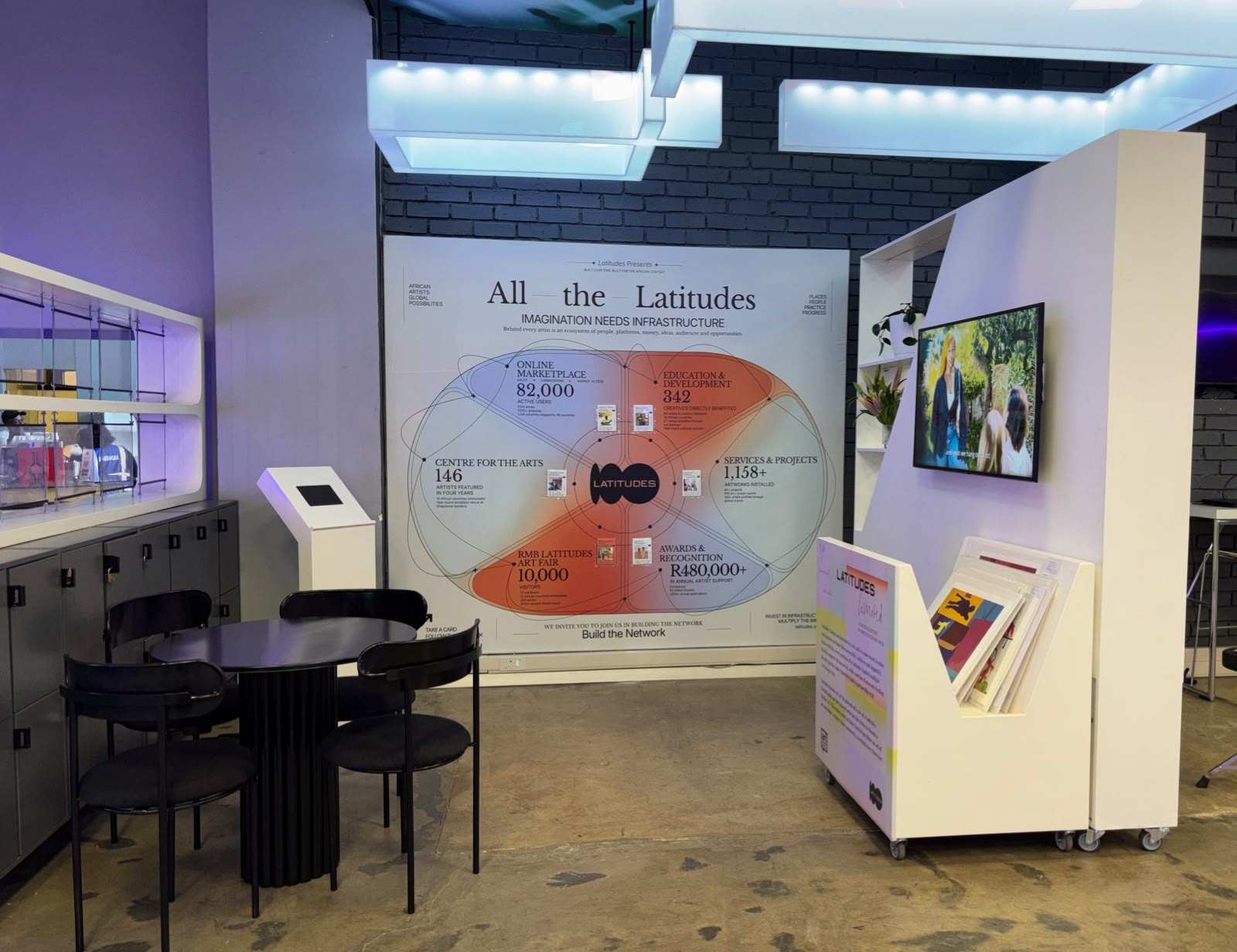
African contemporary art no longer has a discovery problem. It has a conversion problem: how to turn attention into careers, transactions into institutions, and international demand into durable regional markets.
The distinction matters. An artist can be widely photographed, invited to a fair and discussed online while still financing production alone, moving work through unreliable logistics and earning too little to continue. Visibility is an input. It is not infrastructure.
That is the premise behind Imagination Needs Infrastructure, the installation presented by Latitudes at the Fak'ugesi African Digital Innovation Festival in Braamfontein, Johannesburg. Its central feature, Build the Network, maps the people, capital, platforms and knowledge that sit behind an artistic career. The point is not to celebrate an ecosystem as if it were already complete. It is to show where the system still fails to connect.
The economics beneath the attention
Latitudes cites a continental creative economy worth about $60 billion, with the potential to reach $200 billion by 2030 if investment, policy and infrastructure improve. Forecasts of that scale are seductive, but the more revealing number is much smaller. Research by Andani Africa found that 45 per cent of surveyed artists spend more on their practice than they earn, while median annual artist income is R30,000.
Those figures describe the distance between sector-level optimism and individual viability. The problem is not a shortage of creative production. It is the cost and irregularity of everything around it: studio time, materials, documentation, transport, insurance, customs, professional advice and the long periods between sales.
A stronger market therefore requires capital before the point of sale, not only applause after it. Production grants, inventory finance, shared fabrication facilities and reliable payment terms are not peripheral cultural support. They are operating infrastructure.
A continent is not one market
The language of “African art” can obscure the friction between African markets. Latitudes' business development director, Malaika Evans, notes that moving and selling work from one African country to another can be harder than exporting it beyond the continent. Fragmented distribution networks, customs regimes and non-tariff barriers weigh especially heavily on a sector whose businesses usually operate at modest scale.
This changes how collectors and galleries behave. If a cross-border acquisition is unpredictable, buyers retreat toward familiar routes. If a gallery cannot calculate the landed cost of a work, it cannot price confidently. If an artist cannot move work safely, regional visibility does not become a regional market.
The next stage of growth will be measured less by how many African artists enter global auctions and more by whether African institutions, galleries and collectors can transact with one another repeatedly.
Institutions must do more than display
The British Council's 2023 mapping of visual arts across sub-Saharan Africa described infrastructure as unstable and inconsistent, with different weaknesses appearing in each national context: limited institutional capacity, insufficient public support, bureaucratic barriers and fragile professional development.
Galleries remain important because representation can provide strategy, financing, operations and continuity. But there are not enough galleries to represent every serious artist. Latitudes' horizontal model, placing independent artists alongside galleries, curators, studios and nonprofit organisations, is one response. It widens access without pretending that a marketplace alone can replace mentorship, criticism, production support or long-term representation.
This is where museums, universities, fairs, foundations and commercial partners can become more consequential. They can commission research instead of only events; fund multi-year programmes instead of isolated awards; share storage and conservation capacity; support writers and curators; and underwrite the less visible work of moving, documenting and preserving art.
What collectors are actually building
Every acquisition participates in market design. Buying from a local gallery strengthens a representation structure. Buying directly from an artist may provide immediate liquidity but can leave the wider support system untouched. Funding an archive, residency or publication produces no object for the wall, yet may increase the field's capacity to value work accurately over time.
There is no single correct route. The important question is whether capital enlarges the ecosystem or merely extracts from the moment of attention. A serious collector can ask who documented the work, who paid for its production, whether the artist has contractual advice, and which local institution will retain knowledge of the practice after the international exhibition closes.
From a network diagram to a market
Fak'ugesi is an appropriate setting for this argument because digital innovation exposes both the promise and the limits of platforms. Online discovery can collapse distance. It cannot by itself lower customs costs, finance a new body of work or create an independent critical tradition.
Build the Network asks visitors what they can contribute. The strongest answer is not another declaration that African creativity is ascendant. It is a commitment that can be repeated: a purchase, commission, introduction, grant, shipment, essay, apprenticeship or shared resource. Markets become institutions when those actions stop being exceptional.
African art has already won attention. The strategic task now is to make that attention useful.